

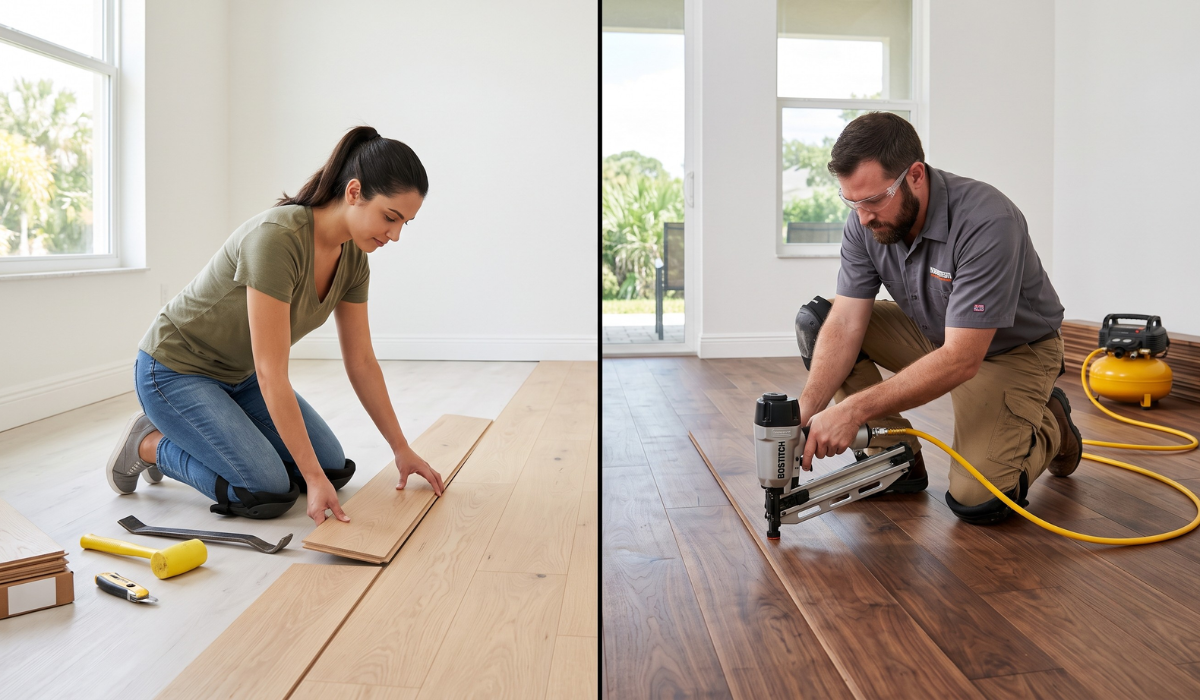
Hardwood flooring installation accounts for roughly 50 percent of total project cost, making it the single biggest financial decision after choosing your product. Whether you install it yourself or hire a professional determines your timeline, your risk exposure, and how much of your budget goes toward the floor itself versus labor. This guide gives you an honest assessment of both paths so you can make the right call for your specific situation. For a complete overview of the hardwood buying process, the complete hardwood flooring guide at Taite Floor.org covers everything from species selection through post-installation care.
The Three Installation Methods and What Each One Actually Requires
Nail-Down: The Traditional Method for Solid Hardwood
Nail-down installation is the standard method for solid hardwood over wood subfloors. A pneumatic flooring nailer drives cleats through the tongue of each board at an angle, mechanically fastening it to the subfloor. It is a permanent, time-tested installation that has been used for over a century.
What it actually requires:
- A pneumatic flooring nailer and compressor (rental available, but technique matters)
- A wood subfloor in good condition, flat to within 3/16 inch over 10 feet
- Moisture testing of both the subfloor and the hardwood before installation begins
- 3 to 5 days of wood acclimation in the installation space
- Experience reading and managing expansion gaps at walls and transitions
Nail-down is not beginner-friendly. The nailer requires consistent technique to avoid splitting tongues or leaving proud fasteners. Subfloor prep is non-negotiable. A first-time installer on a nail-down project is likely to make mistakes that affect the floor’s long-term performance, and some of those mistakes only become visible months after installation when boards start cupping, gapping, or squeaking.
Glue-Down: Engineered Hardwood Over Concrete
Glue-down installation uses a trowel-applied flooring adhesive spread across the subfloor, with planks pressed firmly into the adhesive as you work across the room. It is the standard method for engineered hardwood over concrete slabs and is also used in high-rise construction where nailing into the subfloor is not an option.
What it actually requires:
- The correct adhesive for your specific product (manufacturer specifications matter here)
- Proper trowel notch size to achieve the right adhesive transfer rate
- Concrete moisture testing before installation – a failed moisture barrier is the leading cause of glue-down failures
- Working time management – adhesive has an open time window that you cannot exceed
- A permanent commitment: glue-down floors are extremely difficult to remove later
Glue-down is manageable for a careful DIYer in a straightforward rectangular room, but the adhesive selection and concrete moisture testing steps require genuine knowledge. Getting them wrong produces a floor that delaminates, bubbles, or fails at the adhesive bond within the first year.
Float/Click-Lock: The Legitimate DIY Option
Click-lock engineered hardwood planks snap together at their edges without adhesive or fasteners. The assembled floor floats over the subfloor, held in place by its own weight and perimeter moldings. No special tools are required beyond basic hand tools, a pull bar, and a tapping block.
This is where DIY hardwood installation genuinely makes sense. A careful first-time installer can complete a standard rectangular room in a day with good results. The floor is forgiving of minor subfloor imperfections within manufacturer tolerances, and mistakes are usually correctable during installation rather than after.
The trade-off is that floating floors have slightly more flex underfoot than nailed or glued installations, and they require careful management of expansion gaps, particularly in rooms with temperature fluctuations. They are also not suitable for every space or every product.
Taite Floor.org carries an extensive range of brand-name hardwood products across all installation types. Browse the full hardwood flooring brand catalog to find products with the installation method that fits your project.
Subfloor Preparation: The Step That Decides Everything
Regardless of installation method, subfloor preparation is where most hardwood failures originate. The National Wood Taite Floor Association (NWFA) installation guidelines specify that subfloors must be:
- Clean: free of debris, adhesive residue, and contaminants
- Flat: no more than 3/16 inch variation over a 10-foot span
- Structurally sound: no soft spots, squeaks, or movement
- Dry: within the moisture content range specified by the flooring manufacturer
Professional installers carry moisture meters and straightedges as standard equipment. They assess and address subfloor issues before laying a single board. DIYers frequently skip or underestimate this step, which is the primary reason DIY hardwood installations fail. No amount of skill in laying the boards compensates for a compromised subfloor underneath them.
Honest DIY vs. Professional Cost Comparison
| Factor | DIY | Professional |
|---|---|---|
| Labor cost | Eliminated | $3 to $8 per sq ft depending on method and market |
| Tool investment | Rental or purchase required | Included in labor rate |
| Time required | 1 to 3 weekends for average project | 1 to 3 days for average project |
| Warranty implications | DIY installation may void manufacturer warranty | Professional installation preserves full warranty |
| Error risk | Higher – mistakes can be costly to correct | Lower – experienced installers carry liability |
| Best for | Click-lock engineered, simple room layouts | Solid hardwood, complex layouts, large projects |
A Real-World Scenario: When DIY Pays Off and When It Does Not
Consider two homeowners facing similar projects.
The first is installing click-lock engineered white oak in a 400-square-foot bedroom with a straightforward rectangular layout and a clean, level subfloor. They are comfortable with basic tools and have a free weekend. This is a strong DIY candidate. The labor savings are real, the risk is manageable, and the click-lock format is genuinely forgiving.
The second is installing 3/4-inch solid red oak nail-down across 1,200 square feet of an open-plan main floor with transitions into tile, carpet, and an existing staircase. The subfloor has some squeaky sections that need fastening and a low spot near the kitchen that needs leveling. This project belongs to a professional installer certified by the NWFA. The variables involved, subfloor remediation, transition management, stair nosing, and consistent nail-down technique across a large open area, are precisely where professional experience produces results that a first-time installer cannot reliably replicate.
The savings calculation looks different in each scenario. In the first, DIY saves real money with an acceptable level of risk. In the second, a failed DIY installation costs more to remediate than a professional installation would have cost originally.
Frequently Asked Questions
Can I install hardwood flooring myself?
Yes, with the right product choice and realistic expectations. Click-lock engineered hardwood is genuinely DIY-accessible and can be completed by a careful first-time installer with basic tools. Nail-down solid hardwood and glue-down installations require more skill, specialized tools, and subfloor knowledge. Match the installation method to your experience level before purchasing.
How much does professional hardwood floor installation cost?
Professional hardwood installation typically runs $3 to $8 per square foot for labor, depending on the installation method, your geographic market, subfloor condition, and project complexity. Nail-down solid hardwood and glue-down installations cost more than floating installations. Subfloor remediation, stair work, and custom transitions add to the base labor rate.
What tools do I need to install hardwood floors myself?
For click-lock floating installation: a tapping block, pull bar, rubber mallet, tape measure, pencil, circular saw or miter saw, and spacers for expansion gaps. For nail-down installation: a pneumatic flooring nailer, air compressor, rubber mallet, circular saw, and moisture meter. Nail-down tools can be rented from most home improvement stores, but the technique still requires practice before working on your actual floor.
Does DIY hardwood installation void the warranty?
It depends on the manufacturer. Some manufacturers require professional installation for the warranty to remain valid. Others allow DIY installation if NWFA guidelines are followed and documented. Always read the warranty terms before purchasing if DIY installation is your plan. This is a detail worth confirming before you buy, not after.
How long does hardwood floor installation take?
A professional crew typically installs 500 to 800 square feet per day, depending on the installation method and layout complexity. A DIY installer should plan for one to two days per 200 to 300 square feet for a first project. Acclimation adds three to seven days before installation begins, regardless of who is doing the work.
Ready to move forward? Browse current hardwood flooring specials at wholesale pricing or revisit the complete buying guide to make sure you have everything covered before your project begins.
Read the Hardwood Taite Floor Guide
Shop Hardwood Specials